Fungus gnats, scientifically known as Bradysia spp., are insect pests that cause more damage to greenhouse-grown cannabis during the larval stage than as adults. The larvae thrive in growing media and feed on cannabis when plants are young and moist conditions persist. Adult females lay eggs in the growing medium, and the larvae that emerge (eclose) from the eggs feed on cannabis roots. Fungus gnat adults, in contrast, do not damage plants but can be a nuisance when flying around.
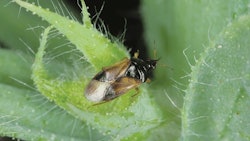
The fungus gnat life cycle consists of an egg, four larval stages, a pupa, and an adult. Generally speaking, a generation can be completed in 20 to 28 days, although development time depends on the temperature of the growing medium. Fungus gnat adults are 3 to 4 mm in length and have wings, long legs, and antennae (Fig. 1, see below). Adults live seven to 10 days and fly around the surface of the growing medium. Adult females lay 100 to 200 eggs into the cracks and crevices of the growing medium after mating.
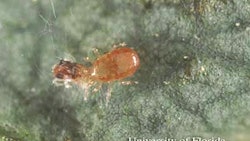
White, translucent, legless larvae are approximately 6 mm long—longer than fungus gnat adults—and eclose from the eggs. Since insects are cold-blooded, they respond favorably to increases in temperature. In general, the higher the temperature, the faster their development occurs. Growers can diagnose fungus gnat larvae by the black head capsule (Fig. 2, see below). Fungus gnat larvae are generally found 2.5 to 5 cm deep in the growing medium; however, depth can vary depending on the type of growing medium. Fungus gnat larvae feed on seedlings and/or young plants’ roots and root hairs. Larval populations thrive in growing media with high moisture contents, and the larvae require a supplemental food source of certain bacteria and/or fungi to complete development.
Fungus gnats, scientifically known as Bradysia spp., are insect pests that cause more damage to greenhouse-grown cannabis during the larval stage than as adults. The larvae thrive in growing media and feed on cannabis when plants are young and moist conditions persist. Adult females lay eggs in the growing medium, and the larvae that emerge (eclose) from the eggs feed on cannabis roots. Fungus gnat adults, in contrast, do not damage plants but can be a nuisance when flying around.
Biology
The fungus gnat life cycle consists of an egg, four larval stages, a pupa, and an adult. Generally speaking, a generation can be completed in 20 to 28 days, although development time depends on the temperature of the growing medium. Fungus gnat adults are 3 to 4 mm in length and have wings, long legs, and antennae (Fig. 1, see below). Adults live seven to 10 days and fly around the surface of the growing medium. Adult females lay 100 to 200 eggs into the cracks and crevices of the growing medium after mating.
White, translucent, legless larvae are approximately 6 mm long—longer than fungus gnat adults—and eclose from the eggs. Since insects are cold-blooded, they respond favorably to increases in temperature. In general, the higher the temperature, the faster their development occurs. Growers can diagnose fungus gnat larvae by the black head capsule (Fig. 2, see below). Fungus gnat larvae are generally found 2.5 to 5 cm deep in the growing medium; however, depth can vary depending on the type of growing medium. Fungus gnat larvae feed on seedlings and/or young plants’ roots and root hairs. Larval populations thrive in growing media with high moisture contents, and the larvae require a supplemental food source of certain bacteria and/or fungi to complete development.
Damage
Fungus gnat larvae feed on developing root systems, which interferes with the plants’ ability to uptake water and nutrients, resulting in wilting and stunted plant growth. Larvae can also cause indirect damage during feeding by creating wounds that allow soilborne plant-pathogenic fungi to enter, thus predisposing plants to infection from soilborne diseases. All wounds are associated with the below-ground portion of the plant: the roots. The extent of root damage depends on the age (size) of the plants, as well as the number of fungus gnat larvae present in the growing medium and feeding.
Figure 1 (top left). Fungus gnat adult. Figure 2 (lower right). Fungus gnat larvae. Note the black head capsule.
Top photo: Theresa Meers, University of Illinois; Bottom photo: Raymond Cloyd
Management
Fungus gnats can be managed using a combination of scouting, cultural practices, insecticides, and biological control agents.
Scouting:Scouting helps detect fungus gnat larvae and adults early in production before populations reach plant-damaging levels. Position yellow sticky cards near the growing medium surface to capture fungus gnat adults, which will aid in detection. Potato disks or wedges placed on the growing medium surface for 48 hours will detect fungus gnat larvae, as they will congregate underneath the potato disks.
Cultural Practices: Water management (i.e. irrigation) will help alleviate problems with fungus gnats. Water accumulation and algae provide ideal conditions for fungus gnat populations to thrive, which can potentially damage plants. Allowing the top 2.5 to 7.6 cm of the growing medium to dry out will serve as a preventive strategy to reduce issues with fungus gnat larvae. The dry surface of the growing medium is less attractive to adult females for laying eggs, and laid eggs will likely desiccate due to insufficient moisture content.
Applying Insecticides:Few insecticides are registered for use in cannabis crop production, which reduces the potential of insecticides as an option for managing fungus gnats. However, the microbial (bacterial-based) insecticide Bacillus thuringiensis subsp. israelensis may be an option for managing fungus gnat larval populations, although fungus gnat larvae must actually ingest the bacterium to be killed. Consequently, applications must be made early in the crop production cycle because the bacterium is more effective on the younger larvae than the older larvae. And while there are insecticides to manage fungus gnat adult populations, these insecticides are not legal to use on cannabis crops, as most are pyrethroid-based insecticides. However, if growers target the fungus gnat larval populations, then fewer adults will be present.
Releasing Biological Control Agents:Biological control agents are the primary means of managing fungus gnat larval populations in cultivation because of the commercial availability of three effective biological control agents: Stratiolaelaps scimitus, the soil-predatory mite; Dalotia coriaria, the predatory rove beetle; and Steinernema feltiae, the entomopathogenic nematode. All three agents must be applied early in production before fungus gnat larval populations reach plant-damaging levels.
Author Note: For more information on fungus gnat management, consult the following publications:
Dr. Raymond Cloyd, Ph.D. is a professor and extension specialist in horticultural entomology/plant protection in the Department of Entomology at Kansas State.