
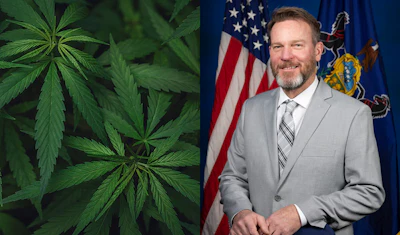

Pennsylvania’s lead Republican champion for adult-use cannabis legalization implied that his fellow GOP lawmakers in the state’s Senate feel they will be politically harmed if they blindly support his reform legislation.
Sen. Dan Laughlin, R-Erie, who has been holding his own adult-use legalization bill hostage in the Senate Law and Justice Committee since last summer, maintains that he can’t gain enough support in the body, which he chairs, until the Democratic-controlled House first passes a companion bill in the lower chamber that has yet to exist.
In the commonwealth’s divided Legislature, Laughlin said his bill’s holdup is politically driven rather than procedurally driven, alluding that other Republicans in his committee feel they’d be “wasting” their vote if there wasn’t a clear pathway for the bill to arrive on Gov. Josh Shapiro’s desk, USA Today Network reported April 15.
“There’s people that are willing to vote for this if they know it’s going to make it to the governor’s desk,” he said. “They don’t want to put up a vote that might harm them, politically harm them, if it’s for nothing.”
In other words, Pennsylvania’s Senate Republicans don’t feel adult-use cannabis legalization is a popular issue among their electorates. This perception appears to align with reality.
While 56% of Pennsylvania’s overall voter population supports adult-use legalization, Republican voters are twice as likely to oppose (64%) as to support (32%) adult-use legalization, according to a February 2026 survey conducted by Quinnipiac University pollsters.
In some of Pennsylvania’s hotly contested state senatorial districts, supporting adult-use cannabis legalization could be the difference in reelection campaigns.
Sen. Joe Picozzi, R-Philadelphia, who vice-chairs the Law and Justice Committee, for example, won his 2024 race by a 50.3%-49.5% margin to unseat Democratic incumbent Jimmy Dillon.
Sen. Tracy Pennycuick, R-Montgomery, also a member of the Law and Justice Committee, is up for reelection this year, after winning her 2022 election race with a 52.1% majority in the 24th District’s shrinking Republican stronghold. Her predecessor, Bob Mensch, saw his 60% landslide victories in the 2010 and 2014 elections shrink to 52.4% in 2018.
Adding to the tension, Pennsylvania’s state legislative districts were redrawn following the 2022 midterm election, and the state’s Democrats claim to have a tailwind heading into the 2026 midterms, with Democratic Gov. Josh Shapiro at the top of the ballot with high approval ratings. In addition, the party not holding the U.S. presidency typically performs well in the midterms.
Shapiro, an advocate for cannabis reform in the commonwealth, has called for adult-use legalization in each of his past three budget addresses, repeatedly vocalizing his frustration about losing tax dollars to neighboring states that have more permissive laws. In 2024, he said he was “sick and tired of losing to friggin’ Ohio,” following the Buckeye State’s voters legalizing adult-use cannabis in 2023.
On April 14, the Pennsylvania House voted, 107-94, to pass Shapiro’s budget proposal, keeping the governor’s expected revenue from an adult-use market in place, with $729.4 million in projected taxes and fees for the latter six months of the upcoming budget cycle if dispensary sales commence on Jan. 1, 2027.
Once an adult-use marketplace is fully implemented, Shapiro expects his proposed 20% cannabis excise tax at wholesale to generate more than $200 million in annual revenue for the commonwealth.
The governor’s $53.3 billion budget proposal increases spending by 5.4% over the current fiscal year. Shapiro proposed that the state extract $4.58 billion out of its rainy-day fund and enact new taxes, such as those on cannabis sales, for another $1.88 billion to balance what would otherwise be a $6.46 billion budget deficit.
House Majority Appropriations Chairman Jordan A. Harris, D-Philadelphia, said the House remains focused on “getting a responsible, balanced budget” done on time.
“This budget continues our investment in public education, support for law enforcement and strengthening Pennsylvania’s economy, all while returning money to working families and not raising taxes,” he said.
But the Republican-controlled Senate is unlikely to go along with the 5.4% spending increase or the inclusion of cannabis tax revenue without an adult-use bill in its final stages.
“We continue to have profound concerns about the level of spending in the budget proposed by Governor Shapiro and passed by the House today,” Senate Republican leaders said in a joint statement. “Moving a budget plan forward is an important step in the process, but much work remains to reach a final agreement which respects taxpayers both now and in the future.”
Under Laughlin’s bipartisan adult-use bill that he introduced with Sen. Sharif Street, D-Philadelphia, last year, there would be a 6% sales tax and an 8% excise tax imposed on cannabis purchases at dispensaries, generating roughly $280 million in tax revenue on a $2 billion marketplace – the size of Pennsylvania’s current medical-only cannabis market.
Only a fraction of that potential tax revenue would be allocated to the state’s general fund under Laughlin’s adult-use proposal: roughly $50 million on a $2 billion marketplace. The rest would be allocated to a Cannabis Regulation Fund and to municipalities and counties that host cannabis businesses.
But none of that matters – at least for this budget cycle – if Pennsylvania House Democrats don’t cater to one Republican’s demands from the Senate and pass a bill that did not originate in their chamber.
“The true path for this, and I’ve said this publicly before, so it’s not new information,” Laughlin told USA Today, “what I would like to see happen is for the House to pass the same language that Senator Street and I have in our bill – just run a companion bill. And if they can pass that, then I can go back to my committee members and my caucus and say, ‘Look, the House already passed the bill.’ You wouldn’t be wasting your vote, in other words.”