
The world’s largest cannabis company is calling on New York Gov. Kathy Hochul to hurry up and sign legislation that aims to prevent out-of-state products from slipping into the state’s regulated supply chain.
Curaleaf, which operates six dispensaries in the state, including three dual-use and three medical-only stores, took out a full-page ad in the New York Post on Sept. 23, urging the governor to sign the “Cannabis Supply Chain and Anti-Inversion Act,” which the state Legislature passed in June.
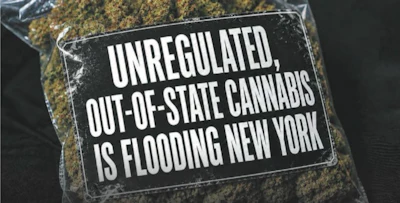
The paid ad showcases a large bag of cannabis flower with a label containing large, capitalized font that reads, “Unregulated, out-of-state cannabis is flooding New York,” adding a message below that tells Hochul, “We can’t afford to wait,” urging her to sign the legislation and “build the safe, responsible cannabis market New Yorkers deserve.”
State lawmakers introduced the act (Assembly Bill A10698B/Senate Bill S8951B) earlier this year after finding that the integrity of New York’s regulated cannabis market “depends on transparency, traceability and lawful origin of cannabis and cannabis products” and that when illicit cannabis enters the supply chain, that “inversion threatens consumer health, undermines public confidence and deprives the state of tax revenue,” all to the disadvantage of compliant licensees.
The legislation specifically establishes a statutory prohibition on “cannabis inversion,” defined as any act or omission involving illicit cannabis. It holds violators accountable through a civil penalty of $10,000 for each day a violation continues, but no more than five times the estimated revenue from the prohibited sale.
The bill would also authorize the state’s Office of Cannabis Management (OCM) to seek suspension orders against licensees or laboratories suspected of cannabis inversion.
Furthermore, the act defines “illicit cannabis” as any flower, concentrate or product on which any tax required to have been paid under state law has not been paid. This extends the definition to include products sourced from unlicensed entities or imported into New York.
The act also prohibits licensees and related businesses from engaging in activities involving fraudulent certificates of analysis, falsified tracking records, undocumented cannabis products, or the sale or transfer of illicit cannabis.
State Sen. Jeremy Cooney, D-Rochester, who sponsored the legislation in the upper chamber, said the bill intends to provide clear definitions to strengthen enforcement actions against “bad actors” who have exploited weaknesses in the state’s regulatory framework.
“We’ve made significant strides in building out a successful legal cannabis market in New York, but this market can only continue to grow if New Yorkers can trust the source and safety of their products,” Cooney said in June. “Illicit products are dangerous and untrustworthy, which is why this bill says enough is enough. It’s time to ensure only legal products are hitting our shelves, to hold bad actors accountable and to uphold the integrity of our legal market.”
The legislation passed with 60-1 and 139-0 majorities in the Senate and Assembly, respectively, more than three months ago, with Assemblymember Landon Dais, D-Bronx, sponsoring it in the lower chamber.
In the New York Post ad, Curaleaf boasted that the bill would preserve and grow good-paying jobs; protect patients and consumers; enable licensed dispensaries to thrive; support farmers and cultivators; and shut down illegal operators.
The Cannabis Supply Chain and Anti-Inversion Act landed on Hochul’s desk nearly 3 1/2 years after adult-use sales commenced in December 2022 in the Empire State via a licensing system that provided first-mover advantages to social equity applicants, particularly those with past cannabis-related convictions and nonprofit organizations that serve them. The state also provided hemp farmers exclusive rights to supply the marketplace.
Hochul orchestrated this “Seeding Opportunity Initiative,” which shut the state’s 10 existing medical cannabis operators, including Curaleaf, out of the adult-use marketplace until the equity operators had a chance to get established. The existing medical operators called it an “abuse” of authority.
Curaleaf didn’t expand some of its New York operations to adult-use sales until January 2024.
Amid the Seeding Opportunity Initiative, licensed adult-use dispensaries recorded a meager $155 million in sales in 2023, and unlicensed shops filled in the demand gaps. In 2026, the state’s licensed dispensaries are now on pace to sell $1.9 billion in cannabis, according to the state’s seed-to-sale dashboard.
Compounding New York’s sluggish program rollout in 2023, the state was years away from launching its track-and-trace system through Metrc, which the OCM didn’t fully implement until earlier this year.
When New York’s adult-use retail market still failed to cross the $1 billion sales threshold in 2024, former Cannabis Control Board Member Jennifer Gilbert Jenkins drew attention to the state’s product inversion problem, calling it the “dirty secret that everybody is talking about.”
That comment came as media reports mounted that California cannabis was “showing up” on and “flooding” dispensary shelves in New York despite interstate cannabis commerce remaining federally prohibited.
Although New York’s licensed retail market is creeping toward the $2 billion annual sales threshold, many believe that figure falls well short of the market potential. In Michigan, for example, licensed dispensaries have reported more than $3 billion in sales each of the past three years, despite serving a population roughly half of New York’s.
As Curaleaf presses for Hochul’s signature to fix what lawmakers acknowledge as an inversion problem, it’s not the first time the company has made headlines for its tense relationship with the governor and state regulators.
In May 2025, Curaleaf Chairman and CEO Boris Jordan called New York’s conversion fee of upward of $15 million for existing medical operators to transition to adult-use operations “un-American.”
“New York is directly targeting and hurting our business,” Jordan told The Post. “New York asked us to invest in the market, and now they’re trying to bring us down.”