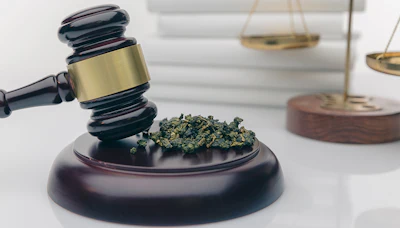

New Jersey’s cannabis law requiring the state’s licensees to sign labor peace agreements (LPAs) and negotiate collective bargaining agreements with unions is preempted by federal labor laws, a judge ruled Aug. 10.
U.S. District Judge Michael A. Shipp dealt Curaleaf a victory in his final judgment that the National Labor Relations Act (NLRA) takes priority over the state’s mandates.
Curaleaf, one of the world’s largest cannabis operators, filed the lawsuit against the New Jersey Cannabis Regulatory Commission (CRC) in October 2025, after state regulators issued the company $610,000 in civil penalties for operating without an active LPA and threatened to revoke its licensure if the company didn’t execute an LPA with a bona fide labor organization by the end of the month.
“That is the commercial equivalent of the death penalty,” Curaleaf argued in its initial complaint.
“If Curaleaf loses its licenses, it will be unable to operate in New Jersey,” according to the complaint. “It will lose revenue from its licensed facilities and may be forced to discharge its personnel. If it loses those personnel, it may also lose irreplaceable knowledge and expertise. It may also sacrifice its accumulated goodwill in the local market. These threats create genuine adversity between the parties.”
Curaleaf currently operates adult-use and medical cannabis dispensaries in Bellmawr, Bordentown and Edgewater Park, N.J., with a cultivation and manufacturing facility in Winslow, N.J., employing roughly 200 full-time and 40 part-time employees.
While Shipp ruled in Curaleaf’s favor, the CRC has the right to appeal the decision in the U.S. Court of Appeals for the Third Circuit.
As one of the most union-friendly states in the U.S., New Jersey has a long history of enacting pro-labor legislation that protects workers’ rights, a legacy the CRC drew on when adopting the state’s cannabis rules.
During her tenure as a CRC Commissioner, Krista Nash has taken a hard stance on holding the state’s cannabis businesses accountable for following the program’s LPA mandates.
“Let me make this very clear: It is time that we favor people over profits,” Nash said in April 2023, when the CRC called an emergency meeting to approve Curaleaf’s licenses with conditional approval – directing the company to provide “evidence of good faith efforts” to negotiate collective bargaining agreements with unionized employees.
After New Jersey voters passed an adult-use legalization referendum in the November 2020 election, the state Legislature adopted the New Jersey Regulatory, Enforcement Assistance, and Marketplace Modernization (CREAMM) Act to govern the marketplace, providing the CRC with the authority to license program participants.
As a stipulation for annual license renewals, the CRC:
- Requires cannabis businesses to sign labor peace agreements with labor unions;
- Limits the unions with which those businesses can sign an LPA (the unions must be considered “bona fide labor organizations” by the CRC); and
- Requires cannabis businesses to negotiate collective bargaining agreements in a good faith effort with the unions within 200 days of opening.
According to Curaleaf, its New Jersey businesses were forced to waive certain federal rights available to it under the NLRA, arguing that the company had to agree to:
- to stay neutral to union organizing;
- refrain from making “negative comments” about the union, union representatives or unionization;
- give the union access to its premises during work time and to speak with employees during non-working time;
- allow the union to designate any potential bargaining unit and to organize at more than one location at a time;
- give the union employees’ contact information;
- announce its neutral stance to employees in an open meeting; and
- recognize the union based on a showing of signed authorization cards.
“Curaleaf did not want any of these terms,” the company argued in its complaint. “Had it been free to negotiate, it would not have accepted any of them. In fact, it would have signed no LPA at all. It agreed to the terms only because it needed an LPA to qualify for a license under New Jersey law.”
Curaleaf argued that the CRC’s labor rules restricted its federal rights to speak its views to its employees about labor unions and collective bargaining, contending that those rights are otherwise protected under the NLRA and the First Amendment.
Curaleaf first negotiated and signed an LPA with the United Food and Commercial Workers Local 360 in April 2022, just ahead of the state’s adult-use sales launch that same month, and began negotiations for a collective bargaining agreement later that year.
Curaleaf’s LPA with Local 360 expired in April 2025, after the parties were unable to reach terms to extend the agreement.
In August 2025, the CRC sent Curaleaf a notice of the $610,000 civil penalty for operating 122 days without an LPA, with the commission voting to fine the company $5,000 per day for the violation.
After Curaleaf brought the case to federal court in October, the CRC filed a motion to dismiss the company’s complaint, arguing that Curaleaf shouldn’t be allowed to “use federal equity” to rewrite state licensing laws in its favor in a market that federal law declares criminal.
“This court should not use its equitable authority to enjoin the very state licensing safeguards that Curaleaf must satisfy to operate in a federally unlawful market,” the state’s regulatory commission argued.
Shipp denied CRC’s motion to dismiss in May 2026.
“What is squarely at issue in this case … is whether the LPA requirement under the CREAMM Act is in violation of federal labor law, and the court fails to see how that issue has a sufficient nexus to the federally illegal conduct to warrant the application of the unclean hands doctrine here,” the judge wrote.
Shipp also determined the New Jersey Office of Administrative Law’s pending proceeding regarding the $610,000 civil penalty wasn’t reason to dismiss the federal complaint.
Separately, Curaleaf filed a motion for a preliminary injunction against the CRA, which the company hoped would prevent state regulators from imposing penalties and licensing consequences against it while the lawsuit remains ongoing.
The judge denied the motion, determining that Curaleaf waited months to file its complaint following the CRC’s August 2025 enforcement notice and therefore failed to demonstrate a likelihood of irreparable harm.
“Such an unexplained and ‘tremendous delay’ of multiple months shows lack of urgency on the plaintiffs’ behalf,” Shipp wrote. “The court finds that this alone is fatal to the plaintiffs' [preliminary injunction] motion and is reason for the court to find no irreparable harm.”
The judge did, however, determine that Curaleaf showed a likelihood of success on the merits that the NLRA preempts New Jersey’s LPA mandates and that the NLRA’s reach “arguably” extends and applies to state-licensed cannabis businesses, despite federal prohibition.
“Although Congress declared cannabis federally illegal, federal law has been applied many times to workers and the labor market within the industry,” he wrote. “The court, accordingly, finds that the LPA requirement is preempted under Machinists, as well as Garmon, and that the plaintiffs have therefore shown a likelihood of success on the merits.”
Shipp issued his final judgment in favor of Curaleaf this week.