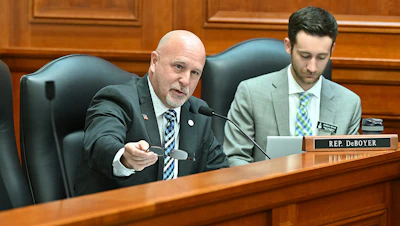

A Michigan state lawmaker announced his plans on Oct. 22 to rein in Democratic Gov. Gretchen Whitmer’s plan to fix the “damn roads” on the backs of the state’s licensed cannabis industry and those they serve.
Rep. Jay DeBoyer, R-Clay Township, promised to “soon” introduce legislation that would suspend the state’s 24% cannabis wholesale tax, which went into effect at the start of 2026. Whitmer devised the new tax as part of a budget plan to repair roads, bridges and other infrastructure throughout Michigan.
DeBoyer, who is running on the 2026 Republican ticket for lieutenant governor, called the 24% wholesale tax “ineffective” and “punitive.”
The wholesale tax is in addition to the state’s 10% cannabis excise tax at retail and 6% sales tax. Industry stakeholders pleaded last year, when Whitmer’s Comprehensive Road Funding Tax Act was included in the state’s $81 billion budget, that the wholesale tax would drive many operators out of business in Michigan’s unlimited license market, where oversupply has led to some of the lowest cannabis prices in the nation.
In August, one cannabis licensee closed five of its nine dispensaries in the Upper Peninsula, citing the new 24% tax as creating an “increasingly unsustainable operating environment,” especially in smaller and rural communities.
Now, DeBoyer wants to suspend that tax for 12 months to allow lawmakers time to reevaluate its effectiveness and to alleviate the burdens he said it has placed on small businesses.
“The road funding plan that taxed marijuana was created and signed in haste by the Whitmer administration to generate revenue, and we’ve seen the impacts of that haste,” DeBoyer said in announcing his proposal. “The tax is generating tens of millions of dollars less in revenue than what was projected, and there’s no enforcement agency to collect it. It’s also driving the marijuana industry back into the black market and forcing business owners who are following the law to compete with nefarious actors. This is a lose-lose.”
Initial estimates projected that the 24% wholesale tax would generate $420.7 million per year, according to a 2025 fiscal analysis. However, the tax generated just $73.4 million through the first six months of 2026, just 35% of what it should have generated, according to the Michigan State Budget Office.
“I supported the original legislation at large for needed road funding, but I was always skeptical to impose a tax with no mechanism to collect it,” DeBoyer said. “The problems with that were clear. This pause is needed to reevaluate the future effectiveness of the tax. Otherwise, it’s a useless tax, and the state is forcing local businesses to pay for a policy that isn’t working as intended. This should be addressed.”
DeBoyer’s proposal comes as the state’s licensed retail market has plateaued at $3 billion in sales projected for this year – a slight dip from the $3.3 billion in sales in 2024 and $3.2 billion in 2025 – and as the average price per ounce remains near an all-time low of $60, according to the Michigan Cannabis Regulatory Agency.
The proposal also comes eight months after a group of eight bipartisan state senators filed legislation to repeal Whitmer’s Comprehensive Road Funding Tax Act entirely. The legislation, Senate Bill 810, was referred to the Senate Government Operations Committee in late February and hasn’t received a hearing.
Sen. Jonathan Lindsey, R-Coldwater, who sponsors S.B. 810, called the 24% cannabis wholesale tax nonessential to Michigan’s pocketbook to the detriment of the state’s cannabis industry.
“I opposed the new tax increase, first and foremost, because it represents an unnecessary growth of government. Lansing’s budget does not need to grow larger; we simply need better discipline,” he said at the time. “This tax will also damage Michigan businesses and lead to widespread job losses across the state, which are already being reported. I also don’t believe that in the long term this mechanism will generate the expected revenue, especially if sales go down as a result of the increased taxes or if legal challenges against the tax prevail.”
With Michigan voters set to elect a new governor on Nov. 3, Republican nominee John James said in August that, if elected, he plans to repeal or sharply reduce the state’s 24% wholesale tax.
James picked DeBoyer as his running mate just before making those plans part of his campaign policy, asserting that elected officials have a “responsibility to respect” the 56% of voters who passed an adult-use cannabis legalization measure in 2018.
“The new 24% wholesale tax (on top of the existing 10% excise plus 6% sales tax) drives up prices, gives illegal operators a competitive edge and has already fallen far short of revenue projections,” James said at the time. “As governor, I will work to repeal or sharply reduce it.”
Meanwhile, Democratic gubernatorial nominee Jocelyn Benson, who currently serves as Michigan’s secretary of state, hasn’t “taken a firm stance” on the 24% wholesale take, calling it a “new and emerging issue” in September, Bridge Michigan reported.
“There’s a lot of data yet to be determined on that particular tax … we need to know where the money is going and also the impact that it’s had on the industry,” she said. “At the same time, I want to make sure that any changes we are making to our tax code do not come at the expense of driving up costs for Michiganders.”
Benson’s running mate, Senate Majority Leader Winnie Brinks, D-Grand Rapids, voted in favor of Whitmer’s 24% cannabis wholesale tax in October 2025.
Shortly after Bridge Michigan reported Benson’s comments, the Michigan Cannabis Industry Association (MiCIA) endorsed James, calling him the “clear choice” for the industry.
MiCIA Executive Director Robin Schneider said James met with MiCIA members to understand the “serious financial challenges” industry operators face.
“Our industry, which has been an economic driver for Michigan, now faces a devastating financial reality,” Schneider said. “We need a leader who will boldly support the cannabis industry and fight for our workers and our businesses,” Schneider said. “John understands that the unlawful 24% tax pushes customers to the illicit market, and he has vowed to repeal or sharply reduce the tax.”
Every major poll in recent months has projected Benson to win the election.