
Michigan Senate Democrats and Republicans are teaming up on legislation to halt the governor’s plan to fix the “damn roads” by making licensed cannabis businesses and consumers foot the bill.
The bipartisan coalition of eight senators filed legislation, Senate Bill 810, on Feb. 26 to repeal Democratic Gov. Gretchen Whitmer’s Comprehensive Road Funding Tax Act. Included in the state’s $81 billion budget, the act implemented a 24% cannabis wholesale tax at the start of 2026 to raise revenue for roads, bridges and other infrastructure repairs throughout Michigan.
This new tax is in addition to the state’s 10% cannabis excise tax at retail and 6% sales tax.
Sen. Jonathan Lindsey, R-Coldwater, who sponsors S.B. 810, called the 24% wholesale tax nonessential to Michigan’s pocketbook to the detriment of the state’s cannabis industry.
“I opposed the new tax increase, first and foremost, because it represents an unnecessary growth of government. Lansing’s budget does not need to grow larger; we simply need better discipline,” he said. “This tax will also damage Michigan businesses and lead to widespread job losses across the state, which are already being reported. I also don’t believe that in the long term this mechanism will generate the expected revenue, especially if sales go down as a result of the increased taxes or if legal challenges against the tax prevail.”
Michigan Court of Claims Judge Sima Patel denied a preliminary injunction in December, which would have stopped the 24% tax from going into effect on Jan. 1, dealing a blow to the Michigan Cannabis Industry Association’s argument that the new tax is constitutional and inconsistent with the 2018 voter-approved statute legalizing adult-use cannabis in the Wolverine State.
In January 2026, Michigan’s licensed dispensaries reported $226.8 million in sales, an 8.3% decrease from last year and their smallest total for that calendar month since 2023, according to the state’s Cannabis Regulatory Agency.
However, the state’s licensed dispensaries also reported nearly 104,000 pounds in adult-use flower sales in January 2026, the highest volume for that calendar month under the six-year program. This was the result of the average price for adult-use flower remaining near an all-time low of $59.07 per ounce in January.
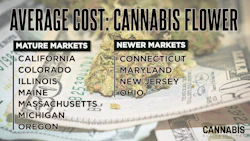
While higher tax burdens are often passed on to the end consumers in most markets, it remains too early to tell what the dispensary price impacts will be in Michigan’s unlimited license market, where oversupply has led to some of the lowest prices in the nation.
But the new tax appears to be a lose-lose in the long run: Either consumers pay more, or businesses see their margins shrink even thinner.
“This is about reining in the government’s constant attempt to get just a little bit more out of people,” Lindsey said. “Lansing must realize that growing government by taxing businesses into oblivion has never been, and will never be, a way to encourage a healthy Michigan economy.”
S.B. 810 has the support of five Republicans and three Democrats signed on for sponsorship in the state’s 38-member upper chamber.
The Michigan Senate voted, 19-17, in October to pass the governor’s Comprehensive Road Funding Tax Act in hopes of the new 24% wholesale tax raising nearly $421 million annually.
At least one senator who voted in the majority to pass the act last year has changed her mind since.
Sen. Rosemary Bayer, D-West Bloomfield, is listed as a co-sponsor on S.B. 810. She did not immediately respond to a Cannabis Business Times’ request for comment.
Lindsey said he only expects support for his legislation to grow as the “damage of this tax becomes more obvious.”
The measure was referred to the Senate Government Operations Committee.