
After legalizing medical cannabis in May 2021, Alabama’s licensed marketplace was originally expected to launch in spring 2023. For patients seeking access, it’s better three years late than never.
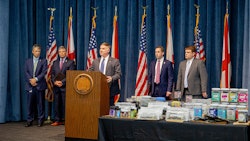
Rex Vaughn, who chairs the 14-member Alabama Medical Cannabis Commission (AMCC), said on March 4 that he expects dispensary sales to commence in late April or early May, News 19 reported.
While the AMCC approved medical cannabis business licensing rules in August 2022 and awarded 21 licenses to various business types in June 2023, the long-anticipated program rollout was marred by legal delays after the commission decided to void those initial awards due to “potential inconsistencies” in scoring the license applications.
The AMCC conducted a series of licensing do-overs, leading to lawsuits from rejected applicants, awarded applicants who had their awards stripped, such as Verano, and others along the litigation lineup.
Now, three years later, AMCC commissioners appear confident that medical cannabis products will land on dispensary shelves in roughly two months, even as some lawsuits over licenses remain ongoing.
“It’s frustrating for us commission members. It’s frustrating for patients who were looking to purchase that cannabis product,” Vaughn told News 19 this week. “And we’re all waiting; the legal system takes a long time to operate.”
Under state law that Gov. Kay Ivey signed nearly five years ago, the AMCC can issue up to:
- five vertically integrated cannabis facilities licenses that could grow, process, transport and operate up to five dispensaries each;
- 12 cultivation-only licenses;
- four processor-only licenses; and
- four dispensary-only licenses that could operate up to three storefronts each.
While the AMCC awarded five vertically integrated facility licenses in December 2023, the commission has stayed the issuance of those licenses amid ongoing challenges.
Meanwhile, the AMCC officially issued nine cultivation licenses and four processor licenses in late 2025, but those operators have nowhere to send their products without dispensary sales commencing.
While there is no limit on testing labs, only one, Green Health Laboratories in Foley, is licensed.
In January, the AMCC also issued three dispensary licenses to CCS of Alabama, GP6 Wellness and RJK Holdings AL, which plan to operate retail facilities in Athens, Attalla, Birmingham, Cullman, Daphne, Mobile, Montgomery, Oxford and Talladega.
A fourth dispensary license was awarded to Yellowhammer Medical Dispensaries, which plans to operate stores in Birmingham, Demopolis and Owens Cross Roads, but the AMCC stayed the issuance of that license while an appeal from an unsuccessful applicant plays out in court.
With perhaps only nine dispensaries licensed statewide for a program rollout, access will be regionally limited.
Another limitation to broad patient access, there are only nine doctors authorized to recommend medical cannabis to qualifying patients, as of late February, including Dr. Roger Buck, a 77-year-old from Gadsden.
“I was surprised to learn, it was fascinating, about the endocannabinoid system, which I was never – I can’t recall ever being taught this in medical school,” Buck told WVTM Birmingham. “There’s really two endocannabinoids, but the main ones, what they do is maintain homeostasis.”
While 60 doctors took the state-mandated course to recommend cannabis, as of December, physicians must receive approval from the Alabama Board of Medical Examiners before becoming certified under the AMCC.
Registered certifying physicians can recommend medical cannabis for more than 15 qualifying conditions, ranging from autism to cancer, depression, epilepsy, panic disorder, post-traumatic stress disorder, multiple sclerosis, a terminal illness, Tourette’s syndrome or any condition causing chronic or intractable pain where traditional medicine/therapy hasn’t worked.
Qualifying patients who register with the AMCC and receive their medical cannabis cards will be limited in product choice – raw cannabis flower and other products that could be smoked or vaped are prohibited under Alabama’s medical cannabis program, as are infused edibles.
Allowable product formats include: tablets, capsules, tinctures, topicals, suppositories, transdermal patches, nebulizers, and liquids or oils for use in an inhaler. For most patients, the daily dosage limit is 50 milligrams of delta-9 THC. Those under 18 years old cannot access products with potencies greater than 3% THC.
“We know for a fact there are a lot of people who suffer from illnesses that traditional medicine does not address,” Vaughn told News 19. “Cannabis might be the secret for what they’re suffering from.”