10 Years of Advances and Adoption
When Cannabis Business Times first launched this exclusive lighting market research in 2016, only 17% of study participants reported using LED technology in the vegetative stage and 15% in flowering stages. By 2022, that percentage had grown to 70%, which marked a milestone for cannabis lighting at the time. Since then, use of LED lighting solutions in veg and flower has continued to expand.
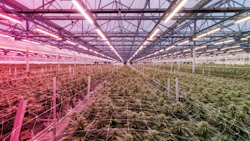
Vegetative: 80% of commercial growers participating in this year’s research reported using “light emitting diodes (LEDs)” for the vegetative stage in their grows. Up slightly from last year’s 78%, that represents a 63-percentage-point increase since this report’s first year. The second most commonly cited vegetative lighting this year was “fluorescent lights (compact, T5, other HO fluorescents)” at 20%.
Some growers used other lighting types in veg in 2025, reporting “high-pressure sodium (HPS) lights” and “metal halide (MH) lights,” at 11% and 10% respectively. (Growers could select more than one lighting type used, so they are not necessarily exclusively using any one type of lighting.) Looking back to 2016, “metal halide (MH) lights” were the most common type of light for veg, used by nearly half (43%) of all participants.
Flowering: In 2016, the first year this study was conducted, HPS took the top spot with 62% of participants using HPS lighting in their flower rooms. As previously noted, just 15% of participants used LEDs in flower that year.
This year, 78% of research participants said they use LEDs in flower, up 1 percentage point from last year. Also holding fairly steady from 2024, less than a quarter (23%) of research participants reported using HPS in flower this year. That reflects a 39-percentage-point drop compared to 2016.
As lighting technology has advanced, more growers who don’t use LEDs or who grow in a greenhouse and don’t use any supplemental lighting for flower are planning a switch.
Exploration of Utility Rebates Continues to Grow
This year, 62% of participants have explored utility rebates to subsidize LED
Factors and Features Influencing Lighting Choices
When considering a lighting feature for the flowering stage, commercial indoor and greenhouse growers in this year’s “State of the Cannabis Lighting Market” study were focused.
Nearly 1 in 4 (24%) ranked “must be LED” as the most important factor when purchasing a lighting fixture (of any type) for flower. “Price” was ranked as the most important factor by 19% of participants. Next in line of the top most important factors were “scientific research supporting product development” (11%) and “product warranty” (10%).
“Energy efficiency,” which was ranked as the most important factor by more growers than any other factor in both 2022 and 2023, was ranked as most important by 9% of 2025 participants. However, 19% of growers ranked “energy efficiency” as their second most important consideration in choosing lighting for flower.
This year’s study participants who grow cannabis commercially in indoor facilities or greenhouses and use or would consider using LEDs for at least one growing stage also ranked their top three most important “considerations for current or future LED use” in cannabis cultivation.
Results in this 10th annual “State of the Cannabis Lighting Market” report followed the same order as last year but with a slightly different balance.
“Crop quality” was ranked as the most important consideration for LED use by more than a third (34%) of participants in this category, down 8 percentage points from 2024. Meanwhile, 31% of participants called out “yield” as their most important consideration, a 5-percentage-point increase from last year. Nine percent of participants said “energy efficiency” was their leading consideration for LED use, compared with 11% last year.
For many of those not ranking “crop quality” as their most important consideration, this consideration was still significant. “Crop quality” was ranked as the second most important consideration for LED use in cannabis cultivation by nearly a quarter (24%) of participants and as third most important by nearly 1 in 5 (19%) participants. Yield ranked as second most important among nearly a third (31%) of growers.
Greatest Lighting Challenges
For commercial cannabis cultivators, challenges don’t end with lighting choices or adoption. While many lighting-related cultivation challenges have been resolved over the years, some familiar challenges appeared again this year. But they were joined by intriguing newcomers.
For the fifth straight year, indoor and/or greenhouse cultivators using lighting ranked “managing energy costs” as the top lighting-related challenge for their operation. While this challenge was ranked in the top spot by 18% of 2025 participants, this represents a 5-percentage-point drop from 2024.
Moving up as 2025’s second most commonly reported “top” challenge with cultivation lighting was “managing heat load” at 16%, up 4 percentage points from last year. Last year, “lighting’s impact on plant growth (yield, internodal spacing, etc.)” ranked in the second spot, but dropped out of the spot this year, falling 5 percentage points to 8%.
Additional top-ranked lighting-related cultivation challenges this year were “adjusting light distance to canopy” (12%), “ensuring consistent/even lighting across crops” (11%), and “how to explore and find the right spectrum” and “lighting’s impact on and terpene/cannabinoid content,” both cited by 8% of participants.
Though small in percentage, some 2025 participants ranked as their “greatest lighting-related challenge” those that reflect the increasing sophistication of cultivation facilities, including “tunable spectrum” (4%), “measurement/data collection” (4%), “automation of spectrum adjustment” (3%) and “automation of intensity adjustments” (3%).
Interest in New Technologies
As lighting technology adoption has
Dimming: For 2025, only 16% of commercial indoor or greenhouse growers using lighting reported that they did not use dimming technology, down 9 percentage points from 2024. Of the 83% of this year’s participants who do use dimming technology, the largest percentages report using “wireless (Bluetooth, Wi-Fi, Zigbee)” (29%); “daisy-chainable T-cables” (21%); RJ45/RJ12 cables (18%); and onboard dimming (17%).
Control systems: Of 2025 participants growing indoors or with lighting in greenhouses, 93% use some kind of control system, up 2 percentage points from last year. The top three types of control systems currently in use: “integrated building automation system” (37%), “light scheduler with sunrise/sunset” (34%) and “environmental control system (0-10V)” (34%).
Tunable spectrum/dynamic lighting: In response to a new question this year, 
Of the growers “actively engaged in exploring or interested in learning more” about tunable spectrum/dynamic lighting, their primary motivation was clear: 70% reported that “enhanced flowering quality or yield” was most important for them to achieve with tunable spectrum/dynamic lighting.
Other top tunable spectrum/dynamic lighting aspirations were “flexibility to adjust lighting across different growth stages” (46%), “improved vegetative growth” (45%), "ability to experiment with and refine light recipes” (39%), and “optimized energy efficiency throughout the cultivation cycle” (39%).
Augmenting top lighting: Of commercial indoor and greenhouse growers with lighting or those considering adding greenhouse lighting within the next 12 months, 78% expressed interest in exploring lighting types to supplement top lighting. That’s a 13-percentage-point increase from last year, and a gain of 27 percentage points since 2022.
To augment top lighting, of greatest interest among growers this year was
Cultivation Facility Benchmarks: Yields, Canopy Size, Vertical Farming
From square footage in canopy to maximizing that footprint with vertical racks, cultivation facilities and their capabilities have changed dramatically over this report’s history, as noted in the key areas that follow:
Total canopy: For 2025 commercial cultivators growing in indoor facilities or greenhouses with lighting, the average area of crop production (total plant canopy) among research participants was 47,800 square feet. Five years ago, in 2020, the average was 34,200 square feet.
The median value for total plant canopy (the number where half of participants fall above and half fall below) was 15,900 square feet, a 27% decrease from 2024’s median canopy of 21,670 square feet.
However, 19% of commercial growers who grow cannabis in indoor facilities or greenhouses with lighting reported a total plant canopy of 80,000 square feet or
Average yields: Total grams per square foot cultivated, on average, across genetics, continued to show the impact of increased cultivation knowledge and technology, as well as perhaps a drive to maximize yield to offset production costs in many markets where price pressure is prevalent.
In 2022, average yields of 50 grams or more per square foot were reported by 55% of research participants. By 2024, 70% of participants fell in that category. 2025 saw the percentage of participants averaging 50 grams or more across all genetics increase to 77%.
Take that up a notch to commercial operations averaging 80 grams per square foot or more across all genetics, and gains have been steady. In 2023, the first year this report included the 80-gram-plus 
In addition, 14% of 2025 participants reported average yields across all genetics of 130 grams or more per square foot, up 2 percentage points from last year.
Vertical racks: This report first asked about vertical racks in 2017. That year, 31% of participants 
In 2025, vertical racks for veg were reported by 46% of participants, up 15 percentage points since 2017. For flower, 26% of 2025 participants reported using vertical rack systems, double the percentage in 2017.
Facility types: As in past years, the commercial cultivators reported operating multiple types of facilities. More than three-fourths (76%) of participants report operating an “indoor facility.” One-third report growing “outdoors” (33%), with another third reporting “greenhouse with lighting” (31%). “Greenhouse without lighting” was reported by 13% of commercial grower participants for 2025, down 6 percentage points from 2024. 
The research indicates, however, that many of those growers cultivate in various combinations of facility types. Forty-four percent of commercial growers grow indoors only, per the research, while 11% cultivate outdoors only, and 11% cultivate in greenhouses only (8% of those grow in greenhouses with supplemental lighting and 3% without supplemental lighting).
When it comes to those growing in multiple facility types, the most common combination includes both indoor facilities and greenhouses with lighting, used by 16% of growers as part of their overall setup. Six percent of research participants report cultivating using all four facility types: indoor, outdoor, greenhouse with lighting, and greenhouse without lighting.
About the Research and Participants
Independent research firm Readex Research conducted the study and compiled the data for the 2025 “State of the Cannabis Lighting Market” report. During July and August 2025, a research questionnaire was sent to all emailable Cannabis Business Times subscribers in the U.S. and Canada. A total of 185 cultivators participated in the study. To provide data-based insights most relevant to cannabis cultivators, this report focuses on the 143 research participants who cultivate cannabis for a commercial operation, for personal use/hobby or both. Results were then refined to exclude non-commercial operations. Unless otherwise indicated, the data reflects participants who grow cannabis commercially indoors and/or in greenhouses, with or without supplemental lighting.
The margin of error for percentages based on the 185 participants who reported they currently own or work for an operation that cultivates cannabis in an indoor and/or greenhouse facility is ±7.2 percentage points at the 95% confidence level.
The geographic breakdown of commercial cultivators who participated in this study is: Northeast U.S. (23%); Midwest U.S. (35%); Southern U.S. (18%); Western U.S. (32%); Canada (11%) and other* (14%). (*Only cultivators with U.S. or Canadian operations were included in the research. However, participants could select “all that apply,” so their operations may be in one or more regions of the U.S. and/or Canada, plus a location outside the U.S. and/or Canada.)