
Massachusetts lawmakers showed no indication of taking up an initiative petition to repeal the state’s voter-approved adult-use cannabis program through the legislative process during a committee hearing on March 23.
Instead, members of the Special Joint Committee on Initiative Petitions gave the third degree to Wendy Wakeman, the spokesperson for the Coalition for a Healthy Massachusetts, the organization behind a 2026 ballot proposal to wipe out the state’s licensed adult-use dispensaries, cultivators and manufacturers.
The campaign filed enough valid signatures in December for its petition, “An Act to Restore a Sensible Marijuana Policy,” to qualify for legislative review. The Massachusetts Legislature has until May 5 to either enact the proposal legislatively or send the campaign back out to collect another 12,429 signatures to secure a position on the November ballot.
Under the proposal, possessing and gifting up to 1 ounce of cannabis or 5 grams of concentrate would remain decriminalized.
Rep. Michael Day, D-Middlesex, targeted that provision, which would allow adults 21 and older to possess cannabis but without access to regulated and tested products geared toward consumer safety.
“It remains decriminalized for the possession,” he said. “So, are we not setting up a black market with this question?”
Wakeman responded, “It’s a great question.”
Day also grilled Wakeman on the campaign’s funding, with $1.55 million – the entirety of contributions made during the signature-gathering drive – coming from out-of-state prohibitionist group Smart Approaches to Marijuana (SAM) Action Inc., a 501(c)(4) organization that does not have to disclose its donors.
“That’s based in Virginia. Is that accurate?” Day asked.
“I believe so. I’m the spokesperson, not the treasurer for the committee,” Wakeman said.
“So, we have no idea of who’s actually paid into SAM Action,” Day said. “And $1.2 million (of SAM Action’s contributions) has been spent on a signature-gathering firm called GroundGame Political Solutions. They’re based … down in Jefferson City, Missouri. Do you know how many signatures were collected by that group?”
Wakeman said just shy of 100,000 signatures. “The strategy with this committee was to use paid signature gatherers,” she said.
“Do you think this effort would’ve made it to the ballot if it weren’t for the paid signature gatherers?” Day asked.
“No,” Wakeman said.
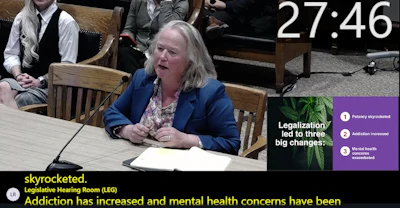
That line of questioning came after Wakeman presented a 10-minute slide show to the committee, arguing why she – along with the parents, teachers, employers, public health professionals and doctors behind the prohibition campaign – believes cannabis legalization has failed to be a “net positive” for Massachusetts citizens.
“Legalization led to three big changes,” she said. “The potency of marijuana that’s available has skyrocketed, addiction has increased, and mental health concerns have been exacerbated.”
Wakeman’s presentation came after Sen. Brendan Crighton, D-Third Essex, who presided over the hearing, inadvertently introduced her as a SAM affiliate.
Wakeman quickly corrected him: She is the initiative petition’s campaign spokesperson. In that role, she receives a $1,500 monthly stipend that comes directly from SAM’s funding.
Wakeman went on to present her slides, several of which included charts and graphics borrowed directly from SAM’s website, including those on the “Rise of Big Tobacco 2.0,” THC potency increases, past month use trends and edible-related poison control calls.
“If you use marijuana before the age of 18, your likelihood of developing cannabis-use disorder increases seven times,” she said. “The daily users of high-potency marijuana are five times more likely to suffer from a psychotic disorder. Some of this is chicken and the egg, right? Marijuana is used by people with mental health issues to self-medicate, people who should be talking to medical health professionals, and some of it might be causation. We don’t know.”
The members on the joint committee didn’t appear ready to goose-step behind the data, especially after Wakeman said, “What we do know is that we don’t have good data.”
Sen. Cindy Friedman, D-Fourth Middlesex, asked, “If that’s really the case and the data isn’t clear, you know, we have a he-said-she-said kind of thing, why didn’t the proponents say, ‘We want to study this?’ … Why isn’t that your question?”
Sen. Paul Feeney, D-Bristol, also questioned whether the data was “just anecdotal” or “just opinion.”
“Do you personally believe that there’s any benefit to cannabis use at all?” he asked.
Wakeman conceded.
“Yes, I believe that the vast majority of people who use cannabis can do so safely,” she said. “That doesn’t mean that we should ignore the fact that a very large portion of the population is affected in a way that’s so negative that it outweighs the benefit of having it freely accessible.”
The majority of Massachusetts voters disagree, including 63% who oppose the petition to repeal the commonwealth’s adult-use cannabis program, according to a February 2026 Bay State Poll conducted by the University of New Hampshire’s Survey Center. Only 20% of likely voters in the survey supported the Coalition for a Healthy Massachusetts initiative.
Sen. Barry Finegold, D-Second Essex, had concerns about the ramifications for the state’s licensed adult-use cannabis businesses, including more than 500 licensed dispensaries and 300-plus licensed cultivators.
“What do you tell all the people that invested all this capital into these businesses, and what happens to them?” he asked.
Wakeman said that was a very difficult question to answer. But, according to the initiative petition, adult-use businesses would have to decide between serving medical patients only or closing their doors.
“I know many people have invested a lot of money in building the marijuana business, and I have a lot of respect for anybody who’s building a business in this climate,” she said. “I just believe that the costs outweigh the benefits.”
Caroline Pineau, the CEO and owner of Stem, a licensed dispensary in Haverhill, Mass., made the ramifications of rolling back the state’s adult-use program clear during her testimony in opposition.
As an economic empowerment operator as part of the state’s social equity program, Pineau’s company has donated more than $400,000 to local nonprofit organizations in the Merrimack Valley since opening in 2020, not to mention $5.5 million in federal income taxes, $725,000 in state income taxes and other local taxes and fees to help essential programs like schools, housing, transportation and health care, she said.
“This initiative would eliminate more than 14,000 Massachusetts jobs in the middle of an affordability crisis,” Pineau said. “It would eliminate hundreds of millions of dollars in state and local tax revenue. It would have ripple impacts through the economy – electricians, carpenters, architects, snowplow drivers, so on, and so forth. It would replace a tax-paying industry that checks IDs and sells safe products with a market controlled by street dealers who will sell untested products to anyone of any age.”