Look back across the 10 editions of the Cannabis Business Times “State of the Cannabis Lighting Market” report, and you’ll see that every report reveals major advances in research and cultivation practices involving LED lighting solutions. With technology pushed near its present-day limits, a new challenge exists: how to get even more out of your LED lighting.
To paraphrase Fluence Horticulture Service Specialist Jason Matlock, Ph.D., the LED lighting narrative has covered efficiency, yields and quality. As the cannabis industry becomes more competitive, sophistication in operations is a major driver of success. As a result, as Fluence Director of Technical Services Chris Bezuyen adds, “Some lighting stories are bigger than lighting.”
With that in mind, Cannabis Business Times turned to a cultivation operation that is using LED technology as part of that sophisticated recipe, to do things it couldn’t do before: Canada-based cannabis producer Cannara Biotech. Cannara’s story is certainly one that goes beyond the traditional “converting to LED lighting” thread and demonstrates how LED technology can push the boundaries of established practices and processes and help set the company up for a more fluid cultivation operation that can adapt in ways it couldn’t previously.
The Quebec-based company, founded in 2018, is a vertically integrated producer of cannabis products cultivated in two mega facilities—one 625,000-square-foot indoor facility and another 1 million-square-foot site with 24 grow zones in a hybrid greenhouse. Cannara is focused on producing “high-grade cannabis at a low cost by leveraging its scale and advanced cultivation techniques,” as its website explains. The company's product offerings include dried flower, pre-rolls, and cannabis oils for both the recreational and medical markets.
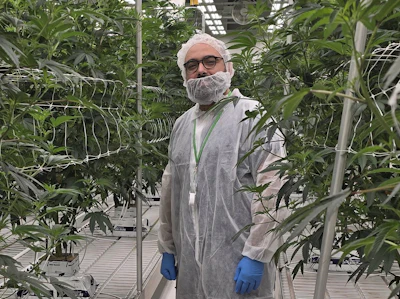
As Cannara’s vice president of production and experimentation, Issam Ben Moussa, Ph.D., has overseen production and cultivation as well as research and development projects.
Retrofitting the greenhouse from HPS lighting to dimmable LED lighting has been a focus for the Cannara cultivation team as a key part of the company’s goals to optimize production using the most advanced technologies available to them to offer its premium products at affordable prices for patients and consumers.
Ben Moussa says that three primary factors drove the decision to switch from HPS to LEDs. “One is the efficiency of energy. Second is the quality. The third is operational flexibility with the LED lighting,” he says. “Flexibility is important at our scale.”
 Neon Sunshine flower grown by Cannara BiotechPhoto courtesy Cannara Biotech
As Cannara has evolved, the company’s smaller, indoor facility has been adapted to support the larger area. Rooms that were previously used for flowering are now devoted to genetic selection and stock plants, where a transition from HPS to dimmable LED lighting had begun. Continuous R&D includes pheno-hunting, and 20,000 to 30,000 clones are propagated every week under the LED lights, then routed to the larger facility for cultivation.
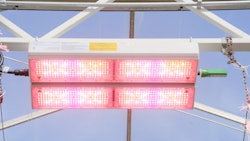
To create the flexibility to use a room for whatever purpose it’s needed—mother plants, veg and/or flower—Cannara is switching veg rooms over to dimmable LED lighting that can accommodate the range of possibilities the future may hold. Eight rooms have transitioned so far, while the goal is to have 18 rooms switched to LED by the end of FY2026.
“When you have stage-specific rooms dedicated for flowering or for veg/moms, it's a bit difficult to do rotation and renew stock plants without interrupting cloning activities,” Ben Moussa says. “With HPS, you cannot use a flowering room for mother plants. However, if you switch to LED, you can.”
He points out that flexibility is critical, allowing him to move his mother plants into a “flower room” if needed. “Because it has LED lighting, I can do cleaning, sanitary/maintenance checks, and conditioning after harvesting a commercial lot and use the room to renew mother plants—all of that without eliminating the existing moms,” he says.
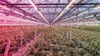
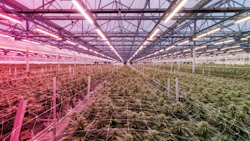
Where Cannara previously had to transfer plants from the clone room to veg and then to flower, they’ve saved a step. Eliminating the veg rooms is in process, so all plants will eventually veg and flower in one space. Inside a Cannara grow room. Eliminating veg rooms is in process, so all plants will soon veg and flower in place.Photo courtesy Cannara Biotech
“From the rooted clones, we transplant directly in the LED room. Because the LEDs are dimmable, you can dim and start your acclimation gradually,” Ben Moussa explains. “We start veg there, then we flip the lights to 12-12, and we start the flowering cycle.”
Bezuyen says that vegging in space is “kind of a new thing that's been happening in the building industry, where they are no longer moving plants area to area.” In addition to allowing the operation greater flexibility, it also cuts labor costs and room-flipping time, among others.
Quality has also played a role in Cannara’s move to LED lighting. As one example, Ben Moussa says the team can better control vapor pressure deficit (VPD)—not just the ambient, but also VPD on the leaf surface.
“With LED, we can have the desired light intensity and spectrum in an area, while avoiding extra heat generated by the HPS,” he says. “This affects the yield, the quality of the flowers at the end. By better controlling the climate in the room, diseases such as powdery mildew are avoided.”
With the transition to LED lighting in its early stages, Ben Moussa says he’s still in the data collection stage, but he’s seen energy efficiency savings of 25% to 30% so far.
With dimmable LED lighting that allows the company to veg and flower a crop in the same room, Cannara is future-proofing its facility for changes in methodology or growing strategy.
While the technology itself isn’t new, Cannara’s deployment of LEDs is another example of pushing through boundaries, expanding opportunities, and getting the most out of LED lighting technology.