
The transcript for the Drug Enforcement Administration’s (DEA) cannabis rescheduling hearing will be made public no later than Aug. 26 after the judge who oversaw the proceedings issued a correction order on Aug. 20.
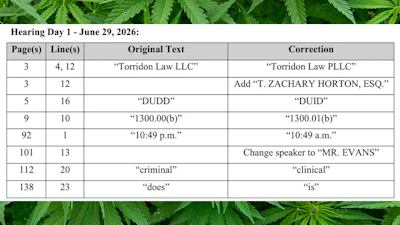
Derek C. Julius, the DEA’s chief administrative law judge, ordered 294 corrections be made to the roughly 2,500-page transcript from the 11-day cannabis rescheduling hearing that concluded on July 15 in Arlington, Va.
The Trump administration’s hearing provided the DEA and seven anti-rescheduling parties the forum to debate the merits of a Biden administration proposed rule to loosen restrictions on cannabis by reclassifying it as a Schedule III drug under the Controlled Substances Act. The DEA was the proponent of the proposed rule.
The DEA and seven opposed parties had until Aug. 17 to review the unofficial transcript and propose corrections to the judge, including, but not limited to, misattributions, mistranscription of statements and spelling errors.
For example, Julius ordered text like “criminal” be corrected to “clinical;” “anal” corrected to “analysis;” “there’s adulterants” corrected to “there’s no adulterants;” “relegate” corrected to “regulate;” “admitted” corrected to “omitted;” “pure” corrected to “impure;” “tantamount” corrected to “detrimental;” “illegal” corrected to “legal;” “naturally” corrected to “not actually;” “dandy” corrected to “candy;” “increase” corrected to “decrease;” “atypical” corrected to “typical;” etc.
The National Drug and Alcohol Screening Association (NDASA) was the lone hearing participant that did not propose any corrections.
The DEA; Smart Approaches to Marijuana (SAM); the states of Nebraska, Idaho and Indiana (the opposed states); Phillip A. Drum, Pharm.D.; DUID Victim Voices; Kenneth Finn, M.D.; and the Tennessee Bureau of Investigation (TBI) timely submitted their proposed transcript corrections, according to Julius.
“The foregoing corrections will be incorporated into the official transcript,” Julius wrote in the order. “The fully corrected transcript will be made available to the public in electronic format on the agency’s website by no later than August 26, 2026. Corrections will be noted in red text on the electronic version; strikethroughs indicate text that has been deleted. In accordance with the tribunal’s practice, personally identifiable information (i.e., email addresses, phone numbers and residential/business addresses) will be redacted from the publicly available version.”
Once the fully corrected transcript is available, Julius has the task of making a nonbinding recommendation to the DEA – whether to keep cannabis listed in Schedule I or move it to Schedule II or III.
DEA Administrator Terry Cole then is expected to make a final decision as to the appropriate schedule for cannabis, which will likely become subject to judicial review. The final transcript will serve as part of the evidentiary record for those hoping to challenge the eventual outcome of this administrative process.
Julius’ order correcting the transcript came three days after the deadline for the DEA and seven opposed parties to file their post-hearing briefs with the tribunal. The briefs allowed hearing participants to enter their proposed findings of fact, conclusions of law and closing arguments into the record.
The DEA made the case that “marijuana can no longer remain in Schedule I,” backing the U.S. Department of Health and Human Services’ (HHS) finding that cannabis has currently accepted medical use and therefore must be reclassified to another schedule.
This finding came from HHS’ 10-month scientific and medical evaluation, conducted by its satellite agency, the Food and Drug Administration (FDA), which led to an August 2023 recommendation that cannabis more appropriately belongs in Schedule III.
During that 10-month review, FDA officials used a new two-part test to determine that cannabis has currently accepted medical use (CAMU) for the treatment of at least three conditions: anorexia related to a medical condition, nausea and vomiting (e.g., chemotherapy-induced), and pain. They only needed to determine that cannabis has CAMU for one condition for it to be removed from Schedule I.
But the opposed parties, in large part, argued that cannabis lacks CAMU under a traditional five-part test used by the FDA and DEA, dismissing the new two-part test as valid. Furthermore, the opposed parties called myriad witnesses to testify that the FDA’s 10-month evaluation from 2023 was severely flawed and outdated.
For its part, the DEA’s post-hearing brief focused not only on defending the two-part test and the 10-month analysis, but also on discrediting nearly all of the opposed parties’ witnesses.
“The opposed parties called several witnesses and attempted to designate them as expert witnesses,” the DEA’s legal team wrote in a 50-page brief. “Many of the so-called expert witnesses do not have the qualifications to be recognized as an expert witness. For the ones who actually possessed the requisite credentials to be recognized as an expert in their respective fields, the opposed party solicited testimony that was well beyond the scope of their expertise or asked them to opine on matters that are not relevant to the ultimate issue. The tribunal should give such testimony little to no weight.”
While the DEA and seven opposed parties could pick and choose which sections of the 11-day hearing to focus their post-hearing briefs on, the transcript, once publicly available, will soon share the full story.