
A Michigan man is asking the U.S. Supreme Court to apply federal law to the federally prohibited cannabis industry after he was denied state and local licenses based on his out-of-state residency.
Kenneth Gay, a Michigan resident, and his counsel for California-based Peridot Tree Inc. filed the petition on Sept. 10, asking the Supreme Court to review whether the dormant Commerce Clause’s nondiscrimination principle applies to state and municipal cannabis-licensing schemes. Gay is the majority owner in Peridot Tree and Washington-based Peridot Tree WA Inc.
Under federal cannabis prohibition, state and local laws that allow for licensed cannabis activities – such as cultivation and dispensary sales – vary significantly. In Washington, for example, cannabis regulators require prospective business licensees to have resided in the state for at least six months before applying for a permit.
In Sacramento, Calif., meanwhile, the city allows only current or former residents to apply for cannabis licenses through its Cannabis Opportunity Reinvestment and Equity (CORE) program.
Both Washington and Sacramento rejected Gay’s applications for a license solely based on his residency, which he argued in the Western District of Washington and Eastern District of California violates the federal dormant Commerce Clause of the U.S. Constitution. The clause bars states from implementing economic protectionist policies that favor in-state businesses and “unduly burden” interstate trade. This helps preserve a national market for goods and services.
The federal district courts dismissed Peridot Tree’s cases, ruling that the dormant Commerce Clause does not apply to cannabis due to its Schedule I status under the Controlled Substances Act (CSA).
In January 2026, the U.S. Court of Appeals for the Ninth Circuit affirmed those decisions, creating a split with a First Circuit ruling from August 2022 that Maine’s state residency requirement for medical cannabis business owners was unconstitutional, and with a Second Circuit ruling in August 2025 that New York’s adult-use cannabis licensing structure, which favored applicants with past cannabis convictions under New York law, was unconstitutional.
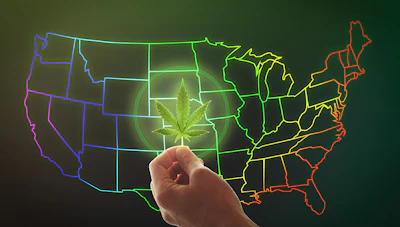
In other words, the First and Second circuits (covering seven states and one U.S. territory) ruled that the dormant Commerce Clause applies to cannabis licensing, while the Ninth Circuit (covering nine states and two territories) ruled it does not.
This circuit court split set the stage for the U.S. Supreme Court to decide the question: Is it unconstitutional for states to prioritize their residents for licensed cannabis business activities?
“Irreparable damage to the burgeoning cannabis market will occur if the [Supreme] Court allows this question to percolate longer,” the Peridot Tree petitioners argued. “Nearly all States with legal cannabis markets limit the number of licenses they issue. If this Court does not restore dormant Commerce Clause protection before these schemes are fully implemented, ‘States [will] be free today to bake in advantages for their residents should Congress later legalize the market, and protectionism would, in the end, have ‘[]disturbed’ a ‘national market for competition’ through ‘preferential advantages conferred by [the] State upon its residents or resident competitors.’”
The Commerce Clause, in conjunction with the Supremacy Clause, allows Congress to pass laws that preempt conflicting state laws regulating commerce.
The Supreme Court explained in 2015 that, “Although the [Commerce] Clause is framed as a positive grant of power to Congress,” as opposed to an express limit on states’ rights, it may still at times bar state laws that unduly restrict interstate commerce even in areas in which Congress has not acted, or is “dormant,” according to the Congressional Research Service.
In other words, just because Congress hasn’t acted on state-protectionist cannabis licensing schemes does not necessarily mean the Commerce Clause doesn’t apply.
The Peridot Tree petitioners argued that the federal illegality of cannabis does not authorize this discrimination.
“The Ninth Circuit’s assumption that applying the nondiscrimination principle to cannabis licensing schemes ‘encourag[es]’ States to create markets ‘for a good that Congress has . . . declared to be illegal’ is backwards,” they argued in the Sept. 10 filing. “When considering whether to legalize cannabis – or other vices – lawmakers must weigh the costs and benefits of such markets. Immunizing cannabis markets from the nondiscrimination principle tilts that balance in favor of legalization because the State’s constituents will reap all the profits.”
When it comes to state-sanctioned cannabis activities colliding with federal law, the petitioners also pointed to the Department of Justice’s April 2026 order to loosen restrictions on medical cannabis as a Schedule III drug, arguing that rescheduling cannabis does not legalize it and therefore does not resolve the circuit court split.
The Peridot Tree petitioners also pointed to the alcohol industry for comparison, citing two Supreme Court decisions: Granholm v. Heald and Tennessee Wine & Spirits Retailers Association v. Thomas.
When the 21st Amendment repealed federal alcohol Prohibition in 1933, states were granted “virtually complete control” over alcohol sales within their borders; however, in the 2005 Granholm vs. Heald case, the Supreme Court ruled that Michigan and New York laws allowing in-state wineries to ship alcohol directly to consumers while restricting out-of-state wineries from doing so were unconstitutional.
In 2019, the Supreme Court similarly struck down – in Tennessee Wine & Spirits Retailers Association v. Thomas – Tennessee’s two-year durational-residency requirement for retail liquor licenses because the law “discriminate[d] on its face against nonresidents” and therefore violated the dormant Commerce Clause.
“If the nondiscrimination principle does not wane in the face of the Constitution’s delegation of primacy over liquor regulation to the States, the CSA’s prohibition of cannabis – which confers no power to the States – cannot implicitly displace it,” the petitioners argued. “The Twenty-first Amendment cases thus embody the principle that the States decide whether and under what system alcohol is sold within their borders. But the nondiscrimination principle governs who may compete in any market a State creates.”
The Peridot Tree petitioners argued that while Congress has declared cannabis illegal, that does not mean Congress has authorized states to discriminate against out-of-state cannabis businesses.
The petitioners pointed out that the question they’re asking the Supreme Court to review is also pending in the Fourth Circuit, and that numerous district courts in other circuits have reached inconsistent results.
“Other jurisdictions have enacted protectionist laws that are ripe for challenge, including Alabama, Arkansas, Delaware, the District of Columbia, Nebraska, and New Jersey,” the petitioners argued.
Should the Supreme Court accept the petition and resolve the circuit court split, potentially reversing the Ninth Circuit’s decision, the ramifications would extend far beyond Peridot Tree’s licensing disputes in Washington and Sacramento – they would impact state cannabis licensing schemes throughout the nation that favor in-state residents, locally owned businesses and applicants with specific social histories, such as those disproportionately impacted by prohibition policies.