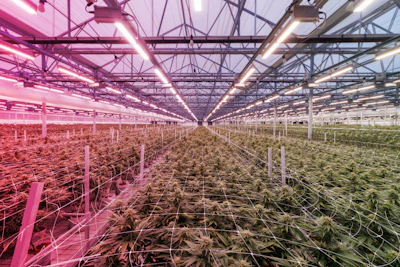

The 10th annual “State of the Cannabis Lighting Market” study asked two new questions: Participants were asked how familiar they are with tunable spectrum/dynamic lighting. They were also asked what was most important for them to achieve with tunable spectrum/dynamic lighting.
The answers confirmed that dynamic lighting is putting the “buzz” in buzzword this year: 85% of research participants were either actively engaged in exploring tunable spectrum/dynamic lighting or interested in learning more. But, despite that interest, half of those individuals reported they aren’t really familiar with this lighting technology.
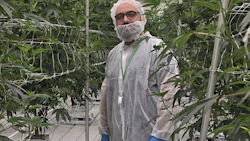
Those research results won’t surprise Fluence Principal Scientist David Hawley, Photo courtesy Fluence
They spoke with Cannabis Business Times to demystify dynamic lighting and answer the questions in many cultivators’ minds—from the research behind the technology to practical applications in the grow.
What Exactly Is Dynamic Lighting?
You may have heard that dynamic lighting is just dimming your light intensity. Manipulating light intensity can be part of that equation, but Hawley points out it’s much broader than that. Even so, it’s not complicated. “Dynamic lighting just means changing something about your light over time. It's as simple as that,” he says.
While dynamic lighting encompasses many aspects of lighting manipulation, Hawley says most conversations about dynamic lighting today revolve around dynamic spectrum. “That’s changing the light spectrum throughout the day or throughout the crop cycle or based on the time of year,” he says.
Why Should Growers Care About Dynamic Lighting?
The potential impact of dynamic lighting technology on a grow is as fundamental as it gets. “Every grower is trying to maximize the bottom line,” Hawley says. “And if they can manipulate anything in their grow to reduce operational costs while maintaining quality or improving quality and yield, they're going to do it with lighting.”
Examples of dynamic lighting applications include dimming supplemental lighting in a greenhouse environment when nature provides sufficient sunlight. Similarly, someone might manipulate their spectrum to enhance the quality and market value of their product or reduce operational cost. Photo courtesy Fluence
Kirk notes that growers are looking for “that silver bullet” to produce the perfect crop. And, while dynamic lighting alone isn’t that bullet, most growers interested in dynamic lighting are focused on changing the spectrum of their lighting fixture.
“They’re looking for a competitive edge, and dynamic spectrum holds that promise,” Kirk says. “We [at Fluence] see the need to help growers produce premium-quality crops at the lowest cost to help them succeed in their business. That’s what we see in dynamic lighting.”
Four Pillars of Opportunity for Dynamic Impact
Hawley says that cultivators have an opportunity to improve their businesses through lighting with four pillars: yield, morphology (aspects of the plant’s shape, form and structure), quality, and economics.
When it comes to economics, dynamic lighting and tunable spectrum are opening new avenues for growers to improve production costs and profit margins.
Hawley explains, “We’ve really seen an opportunity in a dynamic red and white spectrum, because red photons are cheaper to produce. But if you use too many red photons, then you negatively impact plant quality by way of inducing photobleaching or white tips. So, we now believe that the optimal way to produce cannabis is with a dynamic red and white solution.”
Put into practice, this translates to the ability to use a higher red spectrum—and save money—during periods when the plant is less sensitive to red photons and won’t photobleach. “But during developmental stages when the plant is more sensitive to red, you can dial that red down and use a more white spectrum to avoid photobleaching, albeit at a higher operational cost,” Hawley adds.
Dynamic lighting and tunable spectrum make that possible.
What the Research Shows
As different dynamic lighting solutions with different spectra enter the market, knowing what spectrum to choose can be confusing. Kirk invokes Fluence’s slogan “LED by Science” as he explains that belief in red and white spectrum over other color channels is based on research, not anecdotal narratives or lack of technology.
 Inside Light Sky FarmsPhoto courtesy Fluence
“We support growers with confidence, because we’ve done the science, and we know how to guide them to the right products for their applications and their needs,” Kirk explains. “That doesn’t mean we won’t come out with a different type of dynamic product in the future, but we have not seen the specific use cases—backed by science—to justify other parts of the spectrum.”
Hawley reiterates the focus on improvement across the four pillars. And the choice of red and white versus other color channels in dynamic lighting hits the fourth pillar, economics, head on.
“Our research has not yet identified clear value-adding use cases for other parts of the spectrum that you'd want to manipulate,” Hawley says. But why not put those other channels on there if you can? Start with these two reasons:
1. Certain parts of the spectrum can significantly reduce product value. As an example, Hawley and Kirk point to UVB. “The UVB research that we've done so far has found that UVB significantly inhibits yield and reduces quality,” Hawley says, noting that growers could harm their crops with UVB.
2. Diodes cost money. Noting less publicized parts of the spectrum, like blue, cyan, green or amber, Hawley says, “They're expensive diodes to be purchasing and then having on your light fixture and hanging up in the ceiling if it's not actually adding any value to your crop.”
While other channels such as green will drive photosynthesis, they do it much less efficiently—and more expensively—than diodes that are more mechanically optimized. “For instance, white and red diodes have a much higher system efficacy than something like a green diode. You can use green diodes, but it just costs you a lot more money to operate,” Hawley adds.
Just How ‘Tunable’ Is Tunable Spectrum?
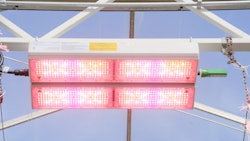
For growers exploring dynamic lighting, Kirk explains it’s important to understand how much flexibility and tunability a fixture truly provides. Fluence’s RAPTR 2 toplight series offers three spectrum options, but only one—the T48 spectrum—delivers full dynamic control.
“The RAPTR 2 with the T48 spectrum is a dual-channel solution that allows growers to adjust the red content from roughly 40% to 80%,” Kirk says. “T48 stands for ‘tunable,’ with red between 40 and 80.” Using proprietary Fluence software, growers can fine-tune the spectrum anywhere within that range to match plant needs at each growth stage. A flower room at Clade9Photo courtesy Fluence
As with any evolving technology, not all manufacturers define “tunable” or “dynamic” the same way. Some fixtures are limited to preset points, while others—like Fluence’s RAPTR 2 T48—enable continuous, precise adjustments. Understanding a fixture’s capabilities and how to apply them is key to realizing the full benefits of tunable dynamic lighting and tailored light recipes.
How Do You Know What Lighting Recipe to Use?
Knowing when to choose a high red or low red spectrum (or anything in between) doesn’t have to be trial or error when there’s research and technical support to guide your choice.
“Over the years of researching photobleaching thresholds or white tip thresholds, we've developed a couple recipes that we think are really optimal for different production objectives,” Hawley explains. Though he and Kirk reserve specific recipes for their customer base, there are research-backed starting-point recipes for growing for flower or for extract or other end goals.
Based on Fluence research, Hawley and Kirk say growers switching to dynamic lighting (with appropriate recipes for their growing goals) typically realize 19% to 20% OPEX savings compared to a static white top light. A flowering plant at Peninsula GardensPhoto courtesy Fluence
Dynamic spectrum provides the “keys to the system” to create your own recipes for cultivars that aren’t sensitive to red light, for example, or when you’re growing for extract and high red risks such as photobleaching don’t matter.
How Can I Optimize My Use of Dynamic Lighting?
While Kirk and Hawley work with growers on grow-specific, genetics-specific lighting recipes, some general strategies on using tunable spectrum can help. More red for veg and more broad white for flower is one example, Kirk says.
“At a high level, utilizing more red light during your vegetative period and more nuanced spectral tuning for your flower period is a much more defined growing strategy. This strategy provides the most efficient way to apply the light that the plant would need at the right time,” Kirk says. “And with light intensities you’re using during these stages of growth, you’re not at a point that you risk the crop damage that we’ve seen at higher light intensity during flower, for example.”
Circling back to Hawley’s simple definition of dynamic lighting, Kirk emphasizes that optimizing your lighting use extends beyond the spectral component, back to the basics.
“Don’t discredit dynamic lighting components such as photo acclimation, proper photoperiod and DLI [daily light interval] management in greenhouses. That would all be encompassed under dynamic lighting because you’re changing the way you’re managing your lighting systems,” he says.
Reflecting on LED technology, Hawley and Kirk talk about the parallel development of technology and the intelligence to use it. “This is kind of the final evolution of LED efficacy,” Kirk says. “You have an efficient light now. How can you use that efficient light more efficiently? Part of it is through this dynamic lighting strategy.”
With dynamic lighting, growers can take further advantage of the lighting technology that is available today and focus on various ways to apply that technology to impact all four pillars of opportunity for cannabis cultivators.
“We just want to get smarter and smarter with our application of the tools,” Hawley says. “That will be the future.”